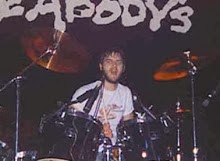
The debut album from June of '44, released in 1995 on Quarterstick Records. I previously wrote about one of their later releases, Tropics and Meridians also released on Quarterstick. I'll refer you to that posting for more background on the group and its evolution. The two albums are similar in style, both fitting somewhere within the post-hardcore and math-rock genres particularly of that mid-90's era, though I don't feel the music to be all that dated. Furthering the similarity between both albums, Engine Takes to the Water is generally short on the number of songs (only 8) but carries a mix of extended cuts that last past six minutes long, and a few that remain less than four. In general I'm quite picky about bands who create songs longer than four to five minutes, often because there isn't enough succinctness. With June of '44, I rarely find this to be a problem though, as creativity and experimentation within the songwriting keeps things fresh and some of the hooks created are just too infectious, I find myself wanting more instead of looking to push the next button. It's Slint worship, and who could go wrong with that?
The fairly common nautical themes exist here as in other June of '44 releases to be sure. The strength of the music is within the guitar play, and play off of each other in particular of the two guitarists, while the bass and drums find their own spaces in each song. Vocals are a mix of spoken words and calls out, sung over the chorus section. The drumming, particularly on a song like "Mindel" is just as up-front and creative as the guitar, in fact I would say the coordination between the instruments is precise and distinct. Subtle use of horn in "I Get My Kicks For You" allows Fred Erksine to really shine in what is one of the more downbeat songs on any of the earlier albums.
June of '44 - Sink Is Busted
A slow thumping beat with scraping skin of my teeth guitar and brief keyboard notes. Then steady rhythmic guitar with soft vocals and the second guitar adding a beautiful hook that is accented by the high-hat play in its second set and more of those soft keyboard notes fluttering around in the mix. The vocals are almost strained towards softness at times. The opening guitar tone returns briefly, followed by a stripped down few bars of simple guitar and cymbal only play. Then when the full accompaniment of instruments and vocals return it feels like a warm wave sweeping in. Another more distinct break leads back into the first part of the song with a jangling key sound, then the song ends.
June of '44 - Mindel
Typical math rock type guitar chords start this song out, the drums once entered do a great job building on the discordant rhythm created by the guitar. This continues through the song, as the percussion is really tested in keeping in line, not getting in the way, but still accenting chord shifts that often are out of whack from the norm. The shifts and changes are certainly married to the band's influences, and "Mindel" is a song you wouldn't expect to find on any of the later June of '44 albums, but it's a perfect representation of where this band started from.
This album sits well out of print but this zipped file of the album in mp3 format for free popped up at this link. Also the record label has the album or individual songs for sale at a very reasonable price at Touch and Go/Quarterstick Records. And if interested in more of the background of this style of music, I fully suggest looking into more of the Louisville, KY bands from the mid '90s on through turn of the century.
Showing posts with label frederick erskine. Show all posts
November 29, 2011
December 7, 2010
Abilene - Two Guns, Twin Arrows
Two Guns, Twin Arrows came out in 2002 on a small label 54º 40' or Fight! based out of Michigan. There is a great in-depth review of this album over at Hardcore for Nerds, which I highly recommend. I'll go ahead and throw my two pennies in here anyways, mostly because I find myself listening to Two Guns, Twin Arrows tonight and really digging it. Abilene was one of guitarist/vocalist Alex Dunham's many bands (Hoover, Regulator Watts, Radio Flyer). Like most (well probably all) of his bands, Abilene's sound is distinctly driven by his guitar sound and play. What set's Abilene's sound on this album apart from Dunham's other bands is Frederick Erskine's presence. Erskine played in other post-hardcore bands such as the mighty June of '44 and Crownhate Ruin. Erskine did not appear on Abilene's first album (s/t) and his role in this album, though not changing the underlying mood of Abilene songs, added a new wrinkle that must have been surprising even to the band themselves. Erskine's influence on the band's music, on the whole, resulted in one of Dunham's most experimental sounding (not unlike some of the June of '44 material Erskine was a part of) creations. So it is with these two creative figureheads in one band, coexisting and allowing each other's creativity and improvisation to flourish, at times complementing, at other times simply getting out of the way of each other, we all end up benefiting. Even if only for this one album's worth of material. I've only hinted at Abilene's sound on this album thus far, as there isn't really any need to try and compartmentalize their sound with any other label than say post-hardcore, which in itself gives little of what to expect.
Abilene - "Twisting the Trinity"
All of the songs on this album, there are eight in total, sit around the five minute mark in length. "Twisting the Trinity" was a solid choice for the first song on the album because it allows for the introduction of each instrument distinctly. Additionally it presents a seperation between the instruments and vocals, as if you can picture each piece sitting in different corners of your bedroom, living room, car, wherever the hell you are listening to this song at the moment. After the initial loud entrance into the song, things are calmed down and the mood takes a darker, cooler feel to it. The song features trumpet and guitar parts that alternate leads. Here we see, maybe more than anywhere else on the album, how these two instruments (and to an almost equal degree the drums) support each other. The secondary instrument, whether guitar or trumpet at the moment, progresses in a way to provide a steady rhythm and basis pulling or grounding the listener. It's not jazz, but you get a similar feeling, just rolled into a rock song.
Abilene - "Fellini"
The trumpet here is used to accent more than anything else in the beginning of this song. When things breakdown a bit about a minute into the song, I find the simple open chord guitar strums as perfectly placed amid Dunham's calls out. About two and quarter through the song, the chords change and a steady pounding pace takes over, which once the vocals subside, the trumpet runs away with the rest of the song. Controlled while still unique.
This album looks to be out of print. You can find a few hard copies of the cd at Amazon. I also came across the whole album available for digital download through a media fire account if you feel so inclined.
Abilene - "Twisting the Trinity"
All of the songs on this album, there are eight in total, sit around the five minute mark in length. "Twisting the Trinity" was a solid choice for the first song on the album because it allows for the introduction of each instrument distinctly. Additionally it presents a seperation between the instruments and vocals, as if you can picture each piece sitting in different corners of your bedroom, living room, car, wherever the hell you are listening to this song at the moment. After the initial loud entrance into the song, things are calmed down and the mood takes a darker, cooler feel to it. The song features trumpet and guitar parts that alternate leads. Here we see, maybe more than anywhere else on the album, how these two instruments (and to an almost equal degree the drums) support each other. The secondary instrument, whether guitar or trumpet at the moment, progresses in a way to provide a steady rhythm and basis pulling or grounding the listener. It's not jazz, but you get a similar feeling, just rolled into a rock song.
Abilene - "Fellini"
The trumpet here is used to accent more than anything else in the beginning of this song. When things breakdown a bit about a minute into the song, I find the simple open chord guitar strums as perfectly placed amid Dunham's calls out. About two and quarter through the song, the chords change and a steady pounding pace takes over, which once the vocals subside, the trumpet runs away with the rest of the song. Controlled while still unique.
This album looks to be out of print. You can find a few hard copies of the cd at Amazon. I also came across the whole album available for digital download through a media fire account if you feel so inclined.
Labels:
abilene,
alex dunham,
frederick erskine,
hoover,
june of '44,
radio flyer,
regulator watts
January 27, 2010
June of 44 - Tropics and Meridians
There's a good review of this album at Time Isn't on My Side, where I first learned about the band. Tropics and Meridians (1996) is my favorite of their albums, and is their second release over all (Engine Takes to the Water was released a year earlier). The group consisted of Fred Erskine, Sean Meadows, Jeff Mueller, Doug Scharin, all of which appeared in numerous other bands mostly around the Louisville, KY area, including Lungfish, Codeine, Rex, Hoover. "Post-hardcore", "math-rock" appear to be thrown around in describing June of 44, but math-rock seems to have evolved into being synonymous with "chaotic" music, which June of 44 and particularly Tropics and Meridians is not. Creativity exists in the song structures, writing, and in the ways they explore the reaches of their instrumentation. Only six songs appear on this release, though the length of songs can be quite long with only one song under five minutes. The recording is solid enough, not spectacular, but does the job.June of 44 - "Anisette"
"Anisette", the first song on the album also happens to be its longest. Its a groovy song, that builds from the drums outward. Interplay from both muted guitars, flows into open strumming setting the tone. Vocals cease the guitars and stand out as calls in the distance. Spoken lyrics begin while both guitars reappear, one panned hard right, the other hard left, playing beautifully off each other,while cymbal accents highlight their unified dance.
The fret slides, going back and forth between the guitars, define the song in my mind. I literally, haven't heard anything like that used like that in a song before. The middle of the song becomes another back and forth, this time between the vocals and the instruments. A return to the fret slides that break into single chord plucks. Then a breakaway and change in direction occurs, slowing the beat down. This rhythm becomes softer while previous lyrics are very subtly spoken in background, almost too quite to be audible to the ear, I didn't pick them up until after a few listens. The song closes by a return to its beginnings.
June of 44 - "Sanctioned in a Birdcage"
The final song on the album is one that is built on a base structure, steady pummeling drums and bass drive this song. One guitar keeps simple time through muted notes spaced over the measure. The other guitar branches out, sometimes adding lush distortion filled chords playing along with the others, than at other times creatively exploring other ways to build the feel and flow of the song. The vocals and lyrics are a perfect fit within the music, mirroring the music, providing an intensity and social-political tint.
Subscribe to:
Posts (Atom)